
Policing Didn’t Break Them. It Let Them Down
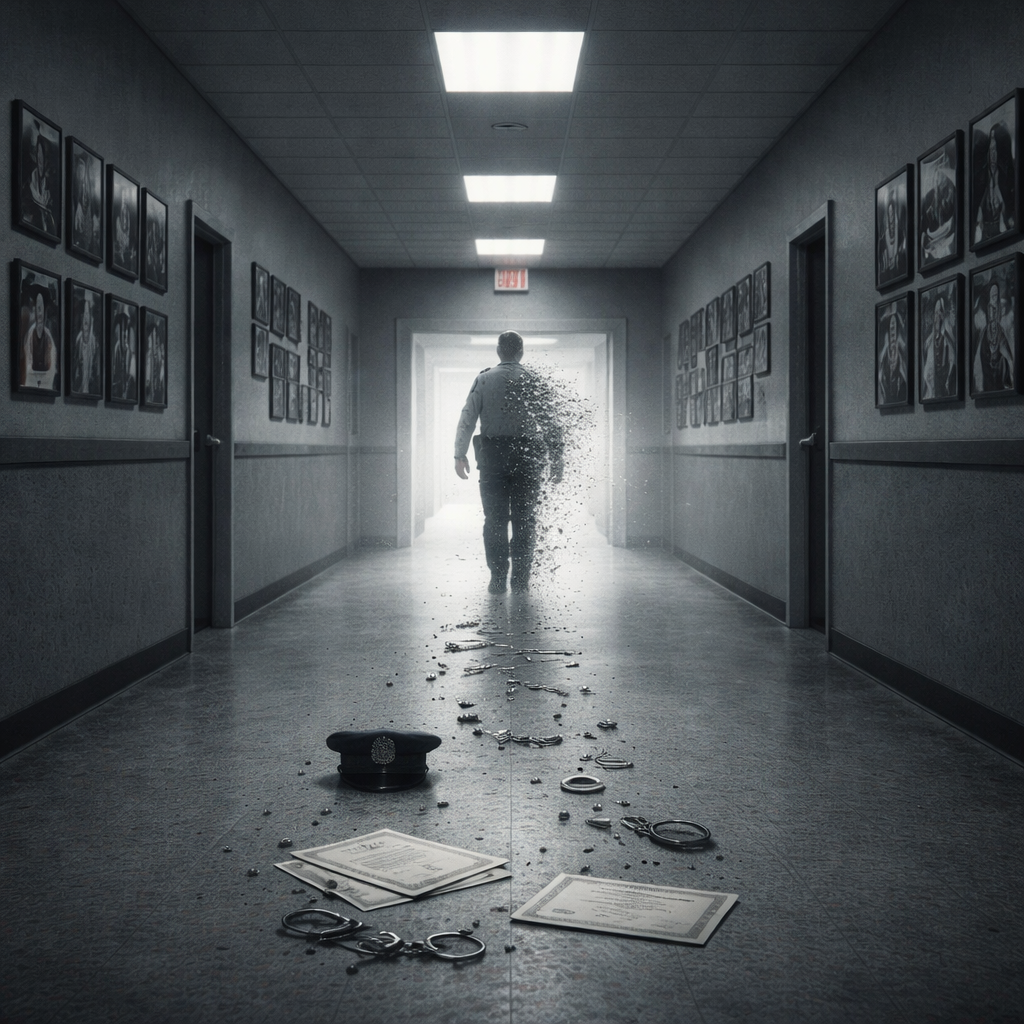
What Happens to Police Officers After the Job Stops Caring
Police officers are not leaving the job.
Policing is leaving them.
That difference matters.
Most people outside the job think officers just quit and move on. Like it was a quick decision. Like they woke up one day and decided they were done.
That’s not how it happens.
People don’t walk away from policing lightly.
They leave after years of giving more than they had.
They leave after bending, stretching, and absorbing pressure until something finally breaks.
And when they leave, it’s rarely loud.
It’s usually quiet.
Resigned.
Exhausted.
They leave after missing birthdays, anniversaries, school plays, and weekends that never came back.
They leave after explaining to their kids, again, why they won’t be home for dinner.
They leave after watching life move on without them while they stay stuck in a roster that never lets up.
They leave carrying trauma home because there was never space to unload it.
No time.
No system.
No real permission.
They learned early that silence was safer than speaking up.
That being “fine” was easier than being honest.
That pushing on was rewarded, while struggling was quietly noted.
Most officers didn’t join for the pay.
If money was the goal, they would have chosen another path.
They joined to serve.
To help.
To make a difference.
They joined because they believed in something bigger than themselves.
So when they leave, it’s not because they stopped caring.
It’s because caring came at too high a cost.
The job stopped caring for them.
Support became a slogan instead of a practice.
Wellbeing became reactive instead of preventative.
Leadership became distant.
Invisible.
Ticking boxes instead of checking in.
And over time, the gap between what policing says and what it does becomes impossible to ignore.
This is where many veterans find themselves after leaving the job.
The uniform comes off, but the weight doesn’t.
There’s a deep sense of loss.
Loss of identity.
Loss of structure.
Loss of belonging.
For years, policing shaped how you moved through the world.
How you slept.
How you ate.
How you spoke.
How you stayed alert.
How you stayed guarded.
Then one day, it’s gone.
No parade.
No decompression.
No roadmap.
Just silence.
Many former officers say the hardest part wasn’t the job.
It was what came after.
The phone stops ringing.
The sense of purpose fades.
And the loneliness creeps in.
You look around and realise most people don’t understand what you’ve seen.
Or what you’ve carried.
Or why you’re still on edge in places that feel safe to everyone else.
And that can be isolating in a way that’s hard to explain.
Here’s the truth that needs to be said more clearly.
Retention isn’t a recruitment problem.
It’s a culture problem.
And the same culture that pushes people out often leaves them unsupported once they’re gone.
Policing keeps asking, “Why are officers leaving?”
But that’s the wrong question.
The better question is this.
“What are we giving them to stay for?”
And an even harder one.
“If you’re in leadership, would you stay in the environment you’ve created?”
That question matters.
Because culture isn’t built by policy.
It’s built by behaviour.
For those who have already left, this matters too.
Because many veterans feel like they failed.
Like they couldn’t hack it.
Like they should have stayed longer.
That’s not true.
Leaving a system that no longer supports your health, your family, or your future is not weakness.
It’s self-preservation.
You didn’t leave because you were broken.
You left because the system was.
And if you’re struggling now, you’re not alone.
Even if it feels that way.
The skills you built didn’t disappear when you left.
Your experience still has value.
Your service still counts.
But you may need time to relearn how to live without constant threat, noise, and pressure.
That adjustment takes time.
And support.
And honest conversations.
Not slogans.
Not posters.
Not empty wellbeing emails.
Real support.
Policing can’t keep losing good people at the rate it is.
And it can’t keep pretending the damage stops when the badge is handed in.
Something needs to change.
Inside the job.
And after it.
Until it does, the least we can do is stop blaming the people who gave everything they had.
And start listening to them instead.
Hear me speak about this
A Healthy Shift Podcast - Episode [335] - What Happens to Police Officers After the Job Stops Caring
About Roger Sutherland
As a coach and advocate for shift workers, my goal is to provide practical, evidence-based strategies that empower individuals to thrive in their roles. By understanding and addressing the challenges of shift work sleep disorder, shift workers can achieve better health outcomes and lead more fulfilling lives both on and off the job.
WORKING WITH A 24/7 WORKFORCE?
A Healthy Shift helps organisations educate their people and build internal shift-work capability through practical, evidence-based shift-work education and Shift Work Champions™.